1920 Communion Bread Recipe: Holy Water and Church Memories

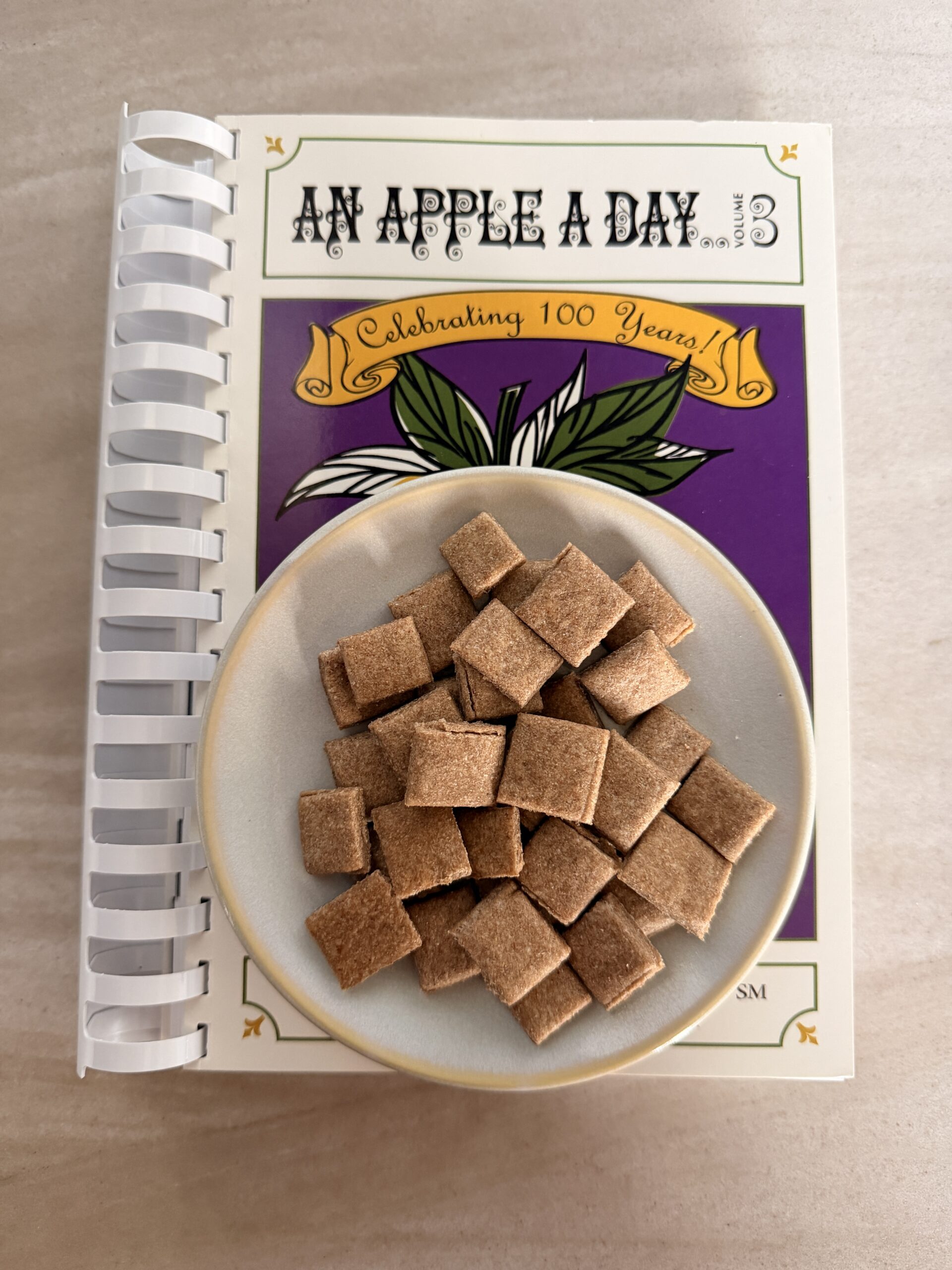
This 1920 communion bread recipe came from my An Apple a Day cookbook and brought back more memories than I expected.
This week’s post is a little late because, well, life got in the way. I had family staying with me the last two weekends, and while I absolutely love when my family comes to visit, it is ideal to have a few weeks in between visits to recover. As a self-proclaimed hermit with agoraphobia tendencies, people in my space—or me having to leave my space—can be overwhelming and exhausting. But here we are: semi-caught up on sleep, working on some self-care, and finally grabbing the An Apple a Day cookbook to see what was next on the list.
I was to make a 1920 communion bread recipe—an old-fashioned cracker that brought back more church memories than I expected.
Now, maybe you know this about me; maybe you don’t, but I grew up Seventh-day Adventist. Looking back on some of the things we did, it feels a lot strange.
There was the boarding school where I attended high school, where I was not allowed to wear anything but skirts—except for gym class and the five afternoons a week I worked in an outdoor-furniture factory. There was the essentially one-room elementary school in the basement of the church. There was the strict observance of Sabbath, from sundown Friday to sundown Saturday, which seemed to go on for a lifetime during the summer.
I could go on and on, but I will not. Suffice it to say, it was different.
So, when I saw Communion Bread on the list this week, I was instantly taken back to the Thirteenth Sabbath. First, the women and men would separate. The women went into one room in the church basement, while the men went into another.
There would be singing, and then we would pair up and wash each other’s feet.
Yes, you read that correctly: wash each other’s feet, like Jesus did for his disciples.
It was always a little weird to me to have my feet washed while I still had pantyhose on, but that is what we did.
After that, we all went back upstairs to the sanctuary to partake in the body and blood of Christ. The blood was grape juice served in tiny, tiny shot glasses, and the body was Communion Bread.
It was always—although I am sure this was not how it was intended—a nice little snack on an extremely long church day. Looking back, I assume different women took turns making the Communion Bread.
I had a very unconventional childhood, for sure. It started out well enough, I suppose. Then the 1970s hit. My father was an alcoholic and used drugs, starting with pot and, I believe, ending with something much stronger. I lived in a haunted house—which my sisters will confirm, though my mother still denies it to this day. My bedroom was in the attic, and I never felt safe up there. I hated walking up those long stairs by myself.
After my mother divorced my father, she began her own spiritual journey. I have written about that many times, and you can read more about it here. (You should read that post. It is a good one.) Anyway, my childhood was not what I would call normal. There was some semblance of normalcy after my mom remarried, but my childhood obviously made me who I am today—perhaps with a different outcome than some people expected. I am not a religious person by any stretch of the imagination. I struggle with the idea of a God who is not good to everyone. Why do some people seem to get away with literal murder while others suffer terribly? I also struggle with the idea that heaven and hell should be dictated by any organization.
So, to say this Communion Bread stirred up a lot of memories and thoughts would be an understatement.
But back to the recipe. True to the form of this cookbook, the recipe itself was weird. It included beating the dough with a wooden potato masher and baking in a “medium-slow oven”, being sure not to brown, because browning gives it a strong flavor…..
It had only four ingredients:
-
2 cups of “entire wheat flour”
-
1/2 teaspoon salt
-
6 tablespoons “purest vegetable oil”
-
9 tablespoons cold water
“Entire wheat flour”? Uhhh.
“Purest vegetable oil”? Uhhh.
I assumed “entire wheat flour” meant 100% whole-wheat flour, so I used that. I was not sure what “purest vegetable oil” meant, so I used the regular “pure” vegetable oil.
But to counteract my very ordinary vegetable oil, I used half tap water and half holy water.
That is right. I happened to have a bottle of holy water in my desk.
It was sitting right next to a bundle of sage, because apparently I am trying to cover all the bases, and doesn’t everyone keep their holy water next to their sage bundle? The bottle was small, so I went with half tap water and half holy water.
The next weird instruction was to “pour in the water in a very slow stream, beating constantly with a silver fork.”
A silver fork. Specifically.
I do not own a silver fork, so I used a metal whisk. It got the job done.
Now, if you have gotten this far into my ramblings, thank you.
The crackers turned out exactly how I remembered them: flavorless, crunchy, and a pile of nothingness.
Much like my taste for anything religious.
Next week, we are scheduled to make something called Boiled Dressing.
Sounds delicious. Insert sarcasm here.