Course Correcting My An Apple A Day Project

My plan was to make one recipe from each section of my An Apple A Day Cookbook Volume One every week. That plan sounded charming on paper. In reality, it meant producing a five‑course meal once a week. That’s a lot of food for two people who don’t eat much on a daily basis. My fridge started to look like a 1960s potluck you couldn’t escape. There had to be some course correcting; otherwise, I would need to find a gastroenterologist and explain why, in 2026, I was making Jell-O molds that included mayo and vegetables.
Then I discovered something that set this course correction in motion.
Last week I contacted the Loma Linda University Medical Auxiliary. My goal was to identify the first names of the women who contributed to Volume One. Honestly, I didn’t expect to hear back. People are busy, and this is just a silly little blog that I’ve long assumed only ten people read—five of whom are related to me. There are days when I even doubted that my mother checked in regularly.
Then an email arrived from the President of the Auxiliary.
She shared some thoughts on how to track down the women’s names and casually offered to send me Volume Three, a collection of recipes compiled in 2009 for the centennial celebration of the Loma Linda University School of Medicine. This edition organizes the book by decade, with the first recipe from 1896, and it decidedly has far healthier recipes.
Just so you know, there are, in actuality, three volumes of An Apple A Day Cookbook, and last Christmas, my sister-in-law gifted me Volumes Two and Three. Since then, they have sat quietly on my bookshelf, minding their own business and gathering dust. Then on Sunday evening, I finally took them down. Suddenly, my vintage An Apple A Day Cookbook project had options. I suppose had I bothered to open Volume Three and do more than just scan the pages when I first got it, we wouldn’t have to be course-correcting.
But, guys, I was thrilled.
Overall, this felt like a more manageable project. If I’m honest, the reason I wanted to hug this book was the complete absence of Jell-O molds. My daughter recently sent me an Instagram post that included the line, ‘My Grandmother knew nine different ways to serve cold shrimp in unflavored jello, and her family recipes should be sealed away in the undersea lightning cage they used to contain the Titans in Disney’s Hercules.’ I agreed with that statement, and I cannot understate this – VERY MUCH! However, the recipes in Volume Three were ones I could look forward to rather than dread.
As I flipped through the book, I noticed something familiar from Volume One: the distinct lack of directions. For example, in a section charmingly titled “Guide for Nut Cookery, 1899,” there is exactly one recipe. That part delighted me. One recipe feels doable. But the recipe is for Oatmeal Crackers, and after listing the ingredients, the instructions simply say:
“Mix the ingredients.”
That’s it.
No baking time. No temperature. No hint as to whether I should put them in the oven or let them sit on the counter and hope for spontaneous cracker formation.
A little digging reminded me that 1899 was the end of the Pioneer Era. These women were using wood or coal stoves, which I most decidedly do not have. They probably didn’t need an oven temperature because they were gauging heat by instinct, experience, and probably by putting a hand in the oven. I, on the other hand, have the usual kind of oven that doesn’t rely on wood and a healthy fear of smoke detectors.
But that’s a problem for next week.
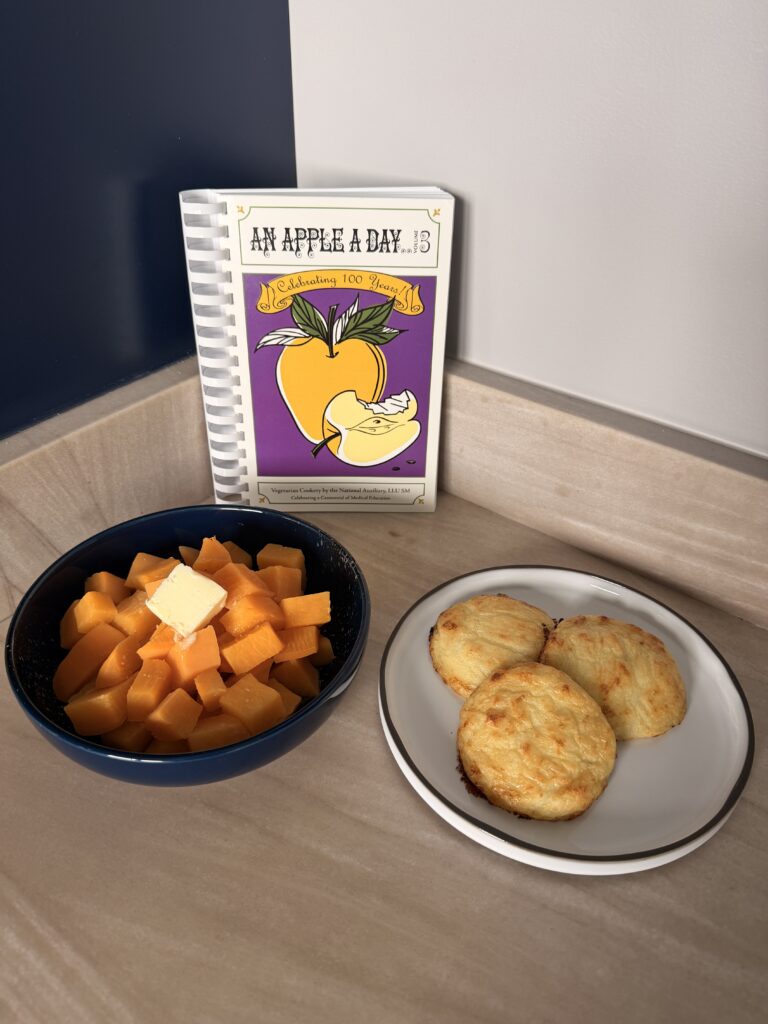
For this week, I cooked the two recipes listed at the very beginning of the book, both from 1896: Potato Cakes and Boiled Turnips. Neither recipe listed an author, which was another interesting difference from Volume One. There were no “Mrs. So‑and‑So” credits; they simply existed, floating anonymously at the front of the book.
Potato Cakes
The recipes themselves were straightforward. The Potato Cakes were to be baked, but again, no oven temperature was mentioned—because, in 1896, oven dials weren’t really a thing and your wood‑burning stove was just “hot” or “not.” So I did what any modern cook would do when faced with historical vagueness: I winged it.
I set my oven to 400°F and hoped for the best.
I wasn’t disappointed.
The Potato Cakes were delicious—crispy on the outside, soft on the inside, and quietly satisfying in the way simple food often is.
Boiled Turnips
The Boiled Turnips. Well, there was an issue with those. I confidently headed to the produce section, grabbed what I thought was a very, very large turnip, and headed to the self-checkout. I typed in “Turnip,” and the screen said, “Not Found.” How could that be? I was staring right at it. I tried again; “Not Found” Flashed on the screen again. I spun the “Turnip” around, found a sticker, and scanned my “Turnip”. The computer screen flashed at me, “Rutabaga”. I just stared at the screen. I grabbed my phone and quickly googled “what is a rutabaga”. Well, turns out it is a cross between a cabbage and a turnip. Knowing there was nothing that resembled a turnip back in the produce department, I just stared at the screen and back at this giant tuber. I stared so long that the cashier, making sure no one stole things at the self-checkout, came up to me and said, “Ma’am, the system says you’re having trouble. How can I help?” Oh, young man, if only you knew. I just told him I was fine and put this giant thing in my bag.
My Boiled Rutabaga/Turnip was, well, a boiled rutabaga. Not great, but slightly better with the addition of a little butter, churned by Pulegra and salt from the little Morton girl and her yellow raincoat.
As I keep going, I’m realizing this project is less about perfectly recreating every “healthy” recipe and more about meeting these cooks where they were—learning to read between the lines of missing instructions, anonymous credits, and assumptions about what every housewife already knew. Volume Three gives me a way to keep exploring that history and those women without burying two modern humans under a weekly mountain of questionable leftovers that eventually ended up in the trash.
Next week, I’ll tackle those mysterious Oatmeal Crackers and see if “Mix the ingredients” can be coaxed into something we’d recognize as food in 2026. I know a lot of you were living for the Jell‑O molds and this week would not have disappointed (Jellied Gazpacho Mold was on tap), but right now, I’m grateful for this gentler pace, nonexistent Jell‑O molds, and a project that feels like it can stretch across decades without breaking my oven—or my appetite.
If any of the recipes excite you, let me know, and I’ll be happy to pass them along.