The Great Caramel Debate | An Apple a Day Cookbook
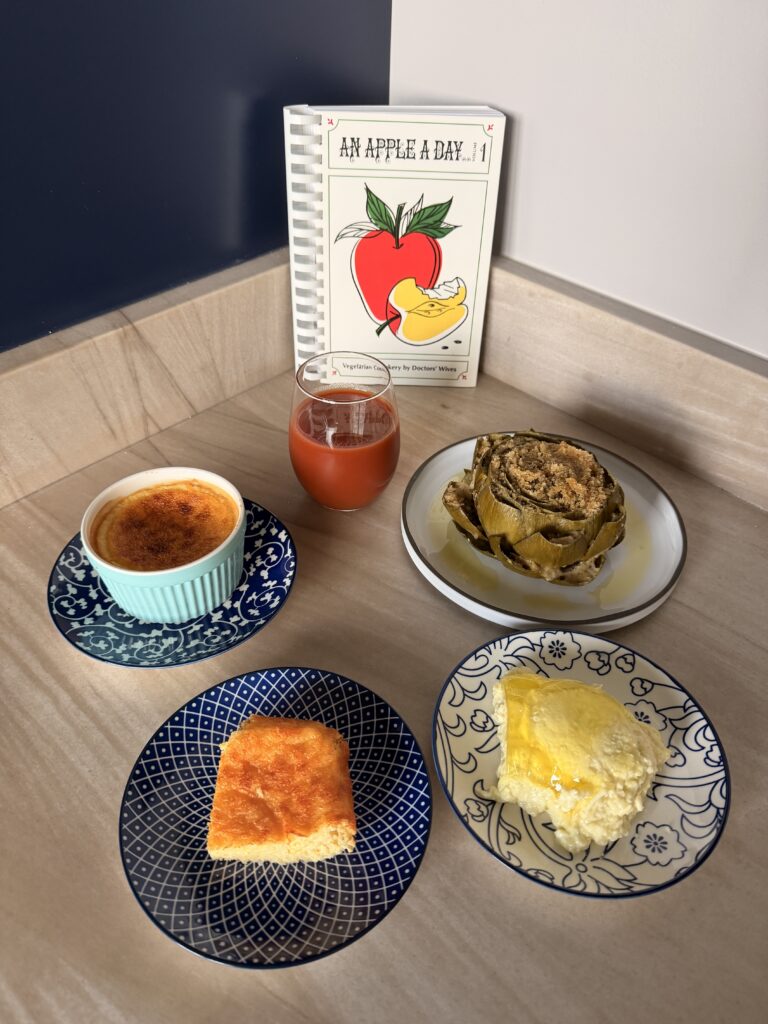
A mystery custard, a stubborn Jell-O salad, and a search for the forgotten women behind a 1967 An Apple A Day cookbook. This week I continue my journey through An Apple a Day, the classic 1967 vegetarian cookbook compiled by the wives of physicians from Loma Linda University School of Medicine. If you missed last week’s post, you can find that right here. I have so many thoughts on this project and the cookbook, but as a refresher for those following along, this week’s menu was to be as follows:
Beverage
Tomato Mist — courtesy of Mrs. Warren W. Bacon
Salad
Spring Salad Ring — courtesy of Mrs. Paul Shearer
Entrée
Cheese Grits — courtesy of Mrs. Forrest Leffingwell
Vegetable
Stuffed Artichokes — courtesy of Mrs. Donovan Hare
Bread
Blueberry Muffins — courtesy of Mrs. Alfred N. Boyd
Dessert
Carmel Custard — courtesy of Mrs. Wellesley Magan
I decided to skip the bread portion of this week’s menu because, in my mind, blueberry muffins are a breakfast food—not something you plop next to dinner. They’ll make an appearance later with a dessert where they belong.
Overall, this week’s menu wasn’t terribly difficult, but it certainly wasn’t without its hiccups. The biggest challenge was convincing my culinary school brain to take a vacation and simply follow the recipes as written. That’s harder than it sounds. Take Mrs. Wellesley Magan’s recipe for Carmel Custard. First of all…Carmel? Was caramel actually spelled that way in 1967? Did the cookbook simply run out of proofreaders? Or was this custard somehow named after Carmel, California? (If so, that’s a plot twist the recipe neglected to mention.)
Then there was the baking instruction: “Bake in pan of water 1 hour or until knife blade comes out clean.”
That’s it.
No temperature.
No hint.
No “good luck.”
Just a confident assumption that I would somehow know.
I went with my instincts and baked it at 325°F, which thankfully turned out to be the right choice. And I’m pretty sure she wasn’t referring to the California town after all because the final instruction says: “To serve, invert molds so that carmel is on top.”
At this point I spent more time arguing with my spell checker than I did making the custard. It was absolutely convinced I meant caramel. I was absolutely convinced I needed to stay faithful to the recipe. The spell checker and I reached an agreement to disagree.
Now…let’s talk about the Spring Salad Ring.
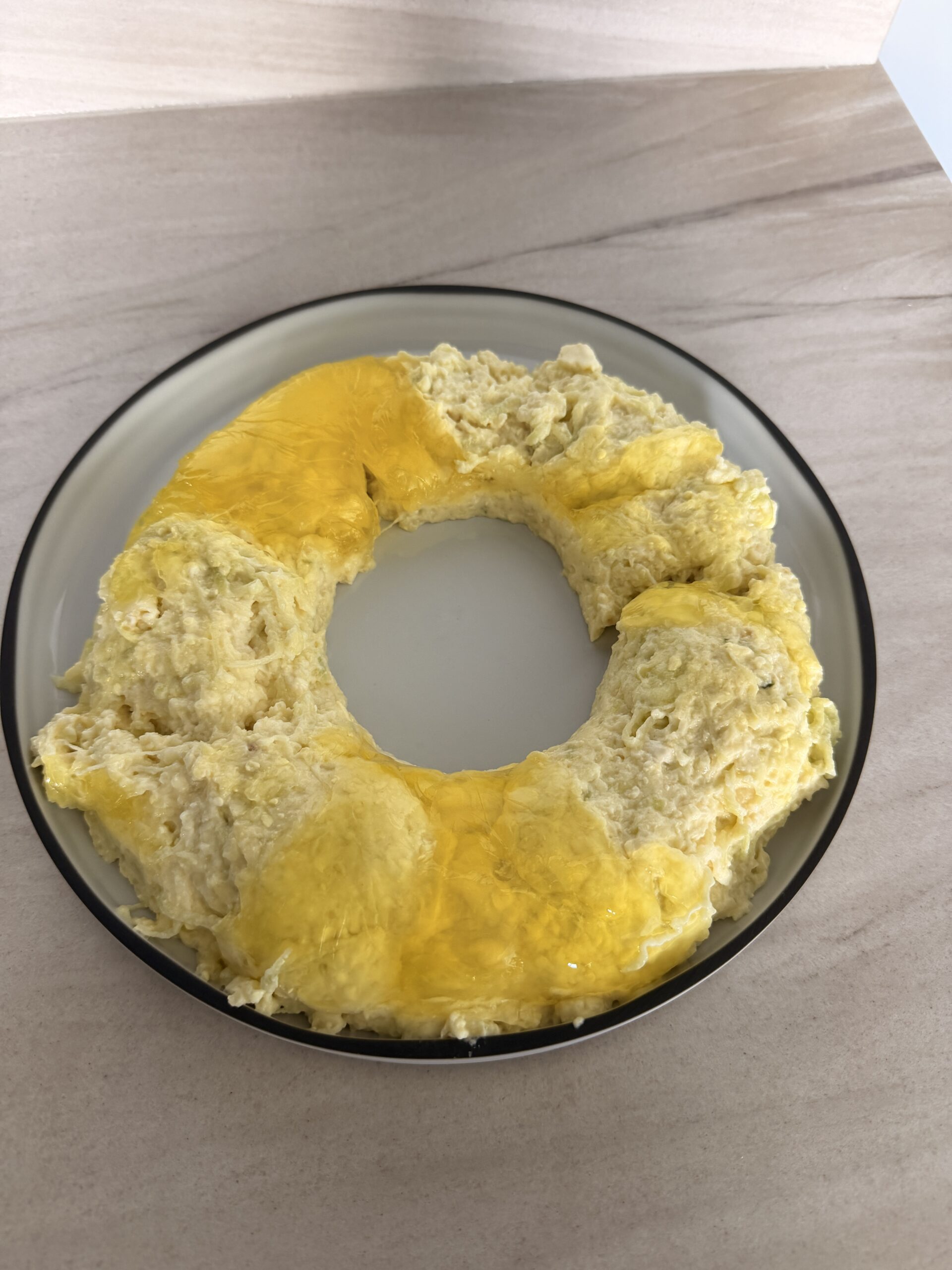
I know this is the recipe everyone in my family has been waiting to hear about. It was, without question, the most stressful recipe of the week. The instructions wanted me to pour a clear gelatin layer into the mold, let it set, and then pour the creamy Miracle Whip, cream cheese, cucumber, and Jell-O mixture over the top. There was just one tiny problem. While I was patiently waiting for the clear layer to set, the creamy mixture had apparently decided it wasn’t waiting for anyone and began setting itself.
Cue mild panic.
I finally shoved the mold into the freezer to hurry things along before adding the second layer. The result? Instead of two beautiful, distinct layers, I ended up with one large, slightly confused layer. On the bright side, it unmolded beautifully. On the less bright side…I’m still not convinced anyone needs an entire slice of Spring Salad Ring.
The rest of the recipes were surprisingly straightforward and, honestly, not bad. Even the Spring Salad Ring was perfectly edible, though I suspect it’s best served in very small portions… or to unsuspecting dinner guests.
But the thing that has stayed with me all week isn’t the recipes. It’s the names. Or rather, the lack of them. Every recipe is credited to someone like Mrs. Wellesley Magan or Mrs. Donald Griggs.
Not Mary.
Not Helen.
Not Ruth.
Just “Mrs.” followed by her husband’s name.
I understand that this was 1967. Women still faced countless legal and social barriers. Many couldn’t easily get a credit card or mortgage in their own name. Some universities admitted very few women. Birth control wasn’t legally available everywhere to unmarried women, and many other opportunities were still limited. So seeing their husbands’ names attached to recipes they almost certainly developed themselves is a reminder of the era in which this cookbook was written.
Still…
It feels unfair. This morning I was talking with my cousin about it, and she wondered out loud whether it would be possible to discover who these women actually were. Challenge accepted. With a little help from AI—and, I’m guessing, a lot of digging through old newspapers, alumni directories, and archives—I’m going to try to identify every one of these women by her own name. As I work through the cookbook, I’ll update each week’s menu with what I discover.
Who knows? Finding the women behind these recipes may end up being even more interesting than the recipes themselves.
Also, tell me: have you ever made a Jell-O salad? Better yet…did you actually like it?